COD Product Research: How to Find Winning Cash-on-Delivery Products (2026)
Direct Answer: How do you find winning COD products?
- •Spy on active Meta campaigns in your target market and rank products by how long their ads have been running — longevity is the strongest profitability signal in COD markets.
- •Check saturation before anything else: count distinct sellers and active ads for the product in your specific country, not globally.
- •Validate with COD-specific unit economics: your margin must survive a 20–40% delivery-failure provision, so aim for at least a 3× markup.
- •Test on a weekly cycle: one product, one week of ads, one clear kill-or-scale decision — then repeat.
In Algeria, Morocco, Egypt and most of the Gulf, cash on delivery is not a payment option — it is the market. The large majority of online orders in these regions are paid at the door, which changes everything about what sells: the customer commits nothing at checkout and can refuse the parcel when the courier arrives.
That is why product research playbooks written for US and European card-payment stores break in COD markets. This guide covers what actually makes a COD winner, the five-step research method, and where to get the data — whether you use free tools or Overview's regional ad intelligence.
Why COD Markets Play by Different Rules
Three structural differences separate COD commerce from card-payment e-commerce, and each one changes your product criteria:
- The sale is not final until the door. Delivery-failure rates of 20–40% are normal in COD markets. A product that wins in Europe on a 15% net margin is a guaranteed loss in Algiers, because your margin must absorb failed deliveries and return shipping.
- Buying is impulse-driven. With no card entry, ordering is nearly frictionless — people order from a Facebook ad in under a minute. Products with an immediate, visual "I want this" effect outperform considered purchases.
- Price ceilings are local. Every COD market has a psychological price limit above which refusal rates explode. Winning products sit inside the local sweet spot, not at global dropshipping prices.
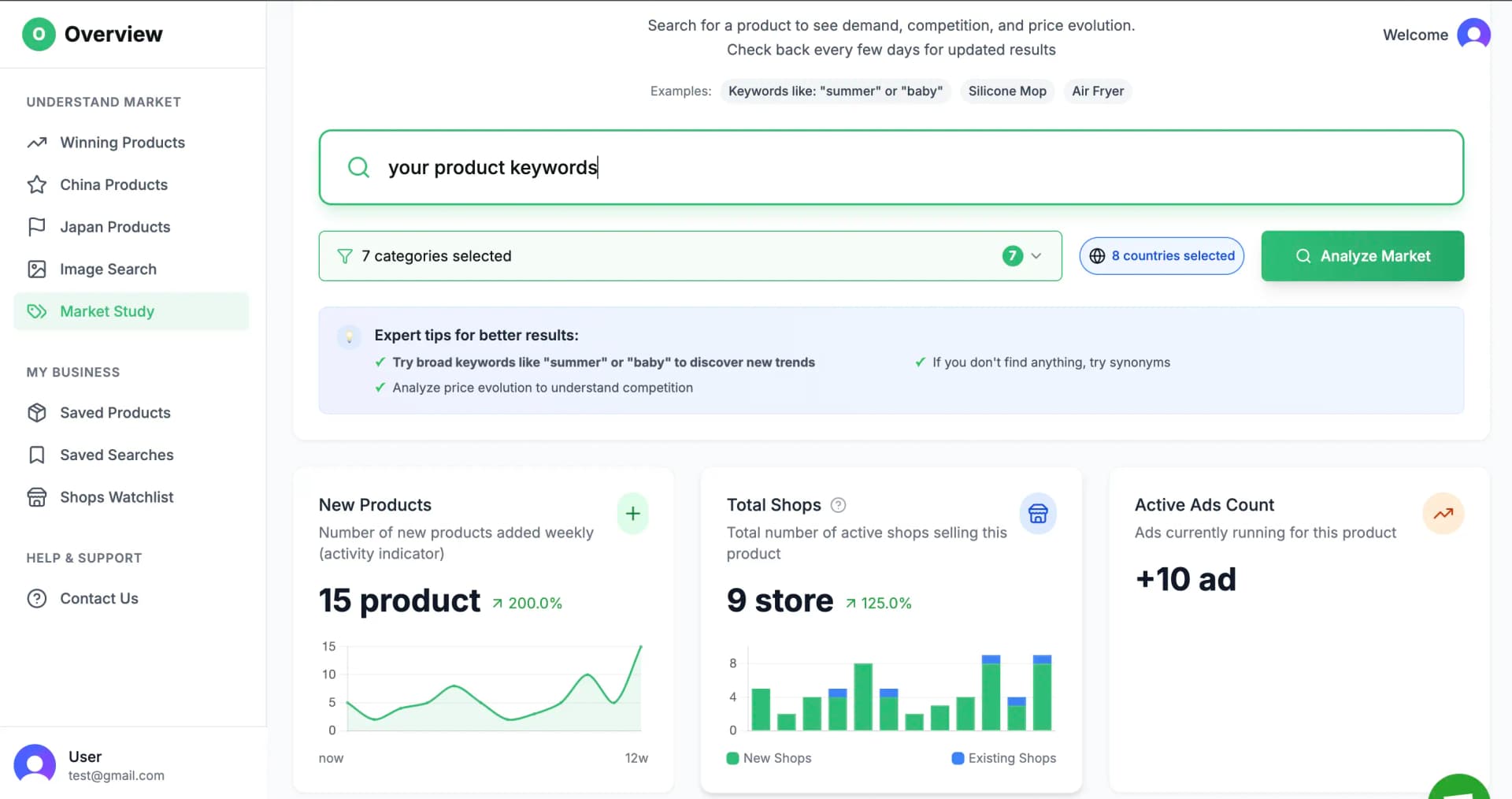
Skip steps 1 and 2 — see today's COD winners by country
Overview's country reports already rank the products with the longest-running Meta campaigns and the lowest saturation in 20+ COD markets, updated from live ad data.
Related: Top-selling products by country — live COD market reports
What Makes a Winning COD Product
Across the Meta campaigns Overview tracks in COD markets, the products that sustain long ad runs share the same profile:
- Visual wow factor — the ad stops the scroll and the product explains itself in three seconds, in any language.
- Solves a felt problem — comfort, time saved, pain relieved. Nice-to-haves get refused at the door more often.
- Sits in the local price sweet spot — high enough to carry your margin plus failure provision, low enough to stay in impulse territory.
- Survives the courier — light, compact, hard to break. Fragile and bulky products bleed margin through damage and return shipping.
- Not yet saturated locally — a product exhausted in France may be untouched in Senegal. Saturation is per-market, and it is measurable.
The 5-Step COD Research Method
This is the repeatable loop used by sellers who launch winners consistently:
- Spy on active Meta campaigns in your target market. Ads are where COD demand is created. List products whose campaigns have been running for weeks — nobody pays to run a losing ad for a month.
- Measure saturation before falling in love. Count distinct sellers and active ads for the product in your country. A handful of sellers means a validated market; dozens mean you are late.
- Read the engagement signals. In COD culture, purchase intent shows up as comments — "price?", "كم السعر", "c'est combien ?". Hundreds of recent price-asking comments is demand you can see.
- Run the COD unit economics. Landed cost × 3 minimum, then subtract a realistic delivery-failure provision (start at 25–30%) and confirmation-call costs. If the margin dies on paper, the product is dead — no matter how viral the ad.
- Test on a weekly cycle. One product, one week of ads, one kill-or-scale decision. This weekly cadence is exactly why Overview offers weekly plans.
Reading the Signals: Longevity, Sellers and Comments
The three signals interact, and misreading them is where most beginners lose money:
Longevity beats virality. A three-day-old ad with a million views proves attention, not profit. A 45-day-old campaign with steady engagement proves someone is making money — advertising budgets do not survive unprofitable products for six weeks.
Sellers follow a curve. One seller with a long-running ad is an opportunity to validate. Three to five sellers is a proven market with room. Dozens of sellers with falling engagement is the saturation cliff — enter there and you are funding their liquidation sale.
Comments are your COD conversion preview. Price-asking comments convert to orders far more directly in COD markets than clicks do in card markets — but check the dates. A wall of price questions from three months ago describes a market that has already moved on.
Where to Get the Data
You can run this method with free tools, paid tools, or both:
- Meta Ad Library (free). Official and free — good for spot-checking a known competitor. Its limits for COD research are structural: no performance signals, no history once an ad stops, no regional filtering. We break this down in our Meta Ad Library alternative comparison.
- Overview. Purpose-built for this exact method: Meta campaigns across MENA, the Gulf and Africa ranked by run-time, saturation scores per country, and AI profit verdicts. The country reports are effectively steps 1 and 2 done for you, updated from live ad data.
- The free ad-creative analyzer. Before spending on your own campaign, score your ad creative for free — hook, content and audience, no card required.
Start With One Market, One Product, One Week
COD product research rewards focus over breadth. Pick the single market you understand best, run the five steps honestly — especially the unit economics — and put one product into a one-week test. Then repeat. The sellers who win in COD markets are not the ones with the biggest budgets; they are the ones with the shortest decision loops. And the data already exists: see what is winning right now, country by country.
More guides
Frequently Asked Questions
What is COD product research?
COD product research is the process of finding products that sell profitably in cash-on-delivery markets — where customers pay the courier at the door. It differs from standard dropshipping research because delivery-failure rates, local price ceilings and per-country saturation decide profitability as much as demand does.
What products sell best with cash on delivery?
Impulse-friendly products with a visual wow factor that solve a felt problem, priced inside the local sweet spot, and light and sturdy enough to survive courier handling. Considered purchases, fragile items and products above the local price ceiling all suffer high refusal rates at the door.
How is COD research different from regular dropshipping research?
Three ways: your margin must absorb a 20–40% delivery-failure provision, so thin-margin winners from card markets are losers in COD; saturation must be measured per country, not globally; and demand signals look different — price-asking comments on Meta ads are the COD equivalent of add-to-carts.
How do I reduce COD delivery failures?
Confirm every order by phone or WhatsApp before shipping, state the price clearly in the ad itself (hidden prices attract refusals), choose couriers with strong coverage in your customer's region, and bake a 25–30% failure provision into pricing from day one so surprises do not kill the product.
Which countries are best for COD e-commerce in 2026?
Algeria, Morocco, Tunisia and Egypt in North Africa; Saudi Arabia, the UAE and the wider Gulf; and Francophone West Africa (Senegal, Ivory Coast) — markets where COD carries most online order volume and competition is thinner than in card-payment markets. Overview publishes live top-product reports for each of them.