Is This Product Already Selling or Saturated in Qatar? (2026 Guide)
⚡ Direct Answer: Is This Product Saturated in Qatar?
- Product saturation in Qatar depends on the balance between active sellers and real market demand, not just the number of listings.
- A product is usually considered saturated if multiple sellers run similar offers with active ads for more than 30 consecutive days.
- High creative repetition and stable pricing across sellers are strong indicators of saturation in Qatar.
- If acquisition costs consistently exceed 35–40% of the product’s selling price during testing, competitive pressure is likely high.
Launching a dropshipping or e-commerce business in Qatar without checking the market first is like driving blindfolded. "Saturation Checking" is the #1 safety step expert sellers take before importing stock or launching ads.
If you skip this, you risk buying inventory that no one wants, or competing against sellers who have already dominated the market. Here are the 3 best ways to check if your product exists in Qatar, ranked from fastest to free.
Method 1: The "Data-Driven" Way (Using Overview)
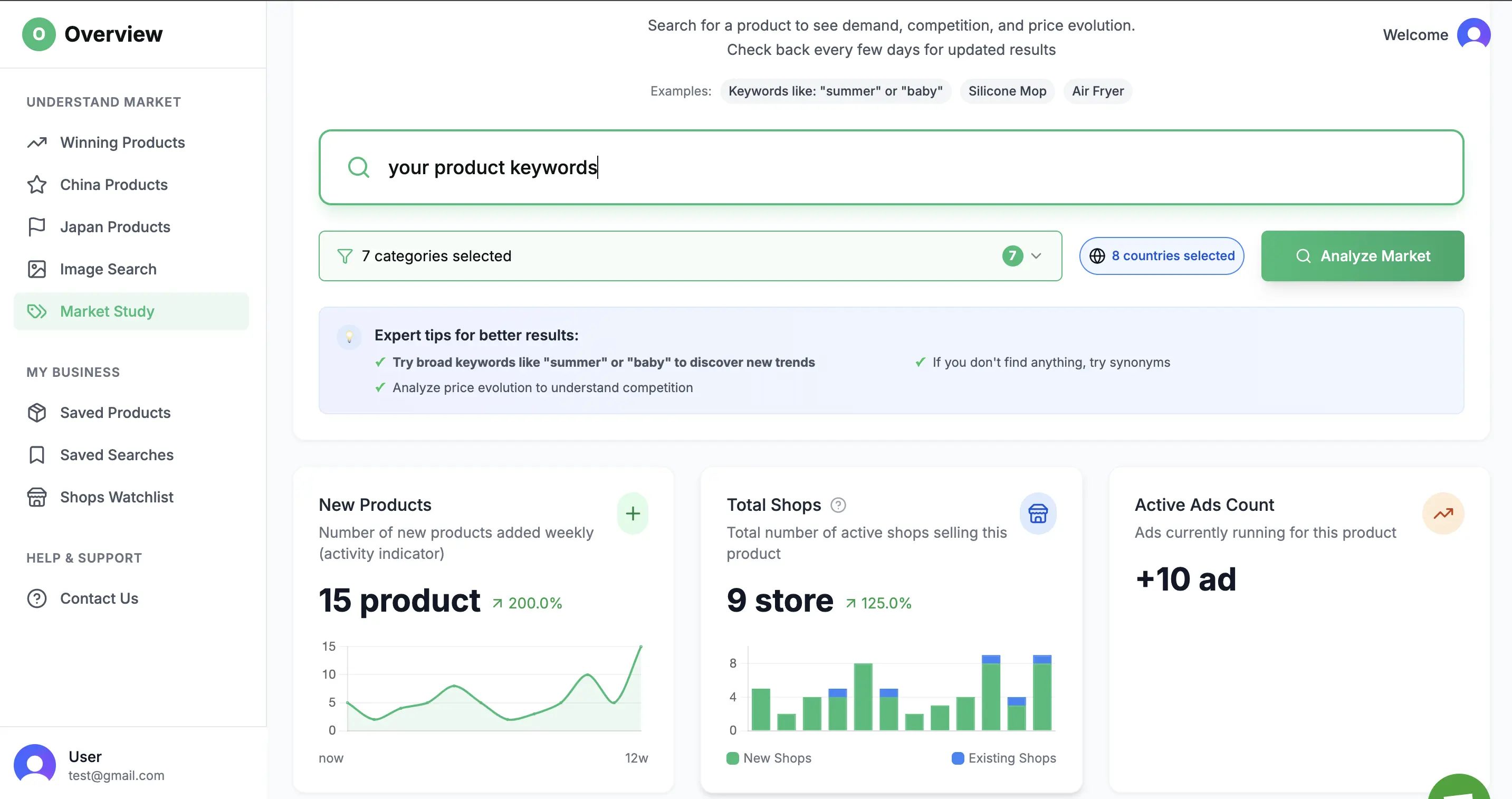
This is how professional teams verify a product in seconds. Instead of guessing, you use real data. Step-by-Step Guide: 1. Open the Market Study Tool on Overview. 2. Set the location filter to Qatar. 3. Search for your product name or category (e.g., "Portable Blender"). 4. Analyze the results. If you see 50+ active ads running for more than 2 weeks, the market is likely competitive. If you see 0-5 results, you might have found a "Blue Ocean" opportunity in Qatar.
💡 Pro Tip:
Before you commit, confirm whether this product is already oversaturated in Qatar. See active ads, competing sellers, and real market pressure instantly.
Method 2: The "Manual Search" (Meta Ad Library)
If you don't have paid tools, you can checking manually. It takes longer but gives you visual proof. How to do it: 1. Go to the Meta Ad Library. 2. Select Qatar as the country and "All Ads". 3. Type generic keywords related to your niche (e.g., if selling a blender, search "Juice", "Kitchen", "Smoothie" in the local language). 4. Scroll through the results. Are there many advertisers selling the exact same item? If yes, it's saturated.
Method 3: The "Organic Feed" Hack
This method helps you find competitors who aren't using obvious keywords. The Process: 1. Create a fresh Instagram or TikTok account. 2. Search for your niche (e.g., #kitchenhacks) and interact with every ad you see. 3. Close the app and reopen it after 1 hour. 4. Look at your feed. The algorithm will now retarget you with every competitor selling similar products in Qatar. If your feed is full of them, it's high competition.
What indicates True Saturation?
You are looking for Advertiser Density. If 10 sellers are selling the same product with the same video, market is bad. If 10 sellers are selling it but with 10 different videos and angles, market is HEALTHY.
How to Beat Saturation
If you love a saturated product, don't change the product. Change the Offer. Bundle it. Brand it. Or ship it faster. That is how you win in Qatar.
Frequently Asked Questions
How do I know if a product is too saturated to sell in Qatar?
A product is likely saturated in Qatar when multiple sellers run similar offers with active ads for extended periods and customer acquisition costs make it difficult to reach break-even during testing.
Can a saturated product still be sold successfully in Qatar?
Yes, but only with differentiation. Sellers in Qatar succeed by improving delivery speed, adjusting pricing or bundles, and using locally relevant branding instead of copying existing offers.
How can I check real product demand in Qatar?
Product demand in Qatar can be validated by analyzing active advertising activity, search interest trends, and organic engagement around the product across social platforms.
Does product saturation mean there are no buyers left?
No. Saturation usually indicates ad or offer fatigue, not lack of demand. Buyers in Qatar may still exist, but they respond better to new creatives, pricing angles, or positioning.